

Introduction
Sleep hygiene has become one of those terms that gets used so broadly it has almost lost meaning. Wellness content online treats it as a catch-all for everything from blue light filters to lavender pillow spray. But not all sleep hygiene advice is equally supported by evidence.
This article separates the habits that have meaningful clinical backing from those that are largely overhyped and explains why sleep hygiene alone rarely fixes chronic insomnia, though it remains a useful foundation.
-

Zopiclone 7.5 mg (Blue)
Insomnia Price range: £105.00 through £675.00 ADD TO CART This product has multiple variants. The options may be chosen on the product page -

Zopiclone 7.5 mg (Zopisign)
Insomnia Price range: £105.00 through £675.00 ADD TO CART This product has multiple variants. The options may be chosen on the product page -

Zopiclone 10 mg (Zopisign)
Insomnia Price range: £110.00 through £685.00 ADD TO CART This product has multiple variants. The options may be chosen on the product page -

Zopiclone 7.5 mg (White Pills)
Insomnia Price range: £105.00 through £675.00 ADD TO CART This product has multiple variants. The options may be chosen on the product page
What Sleep Hygiene Actually Means
In clinical terms, sleep hygiene refers to a set of behavioural and environmental practices that support normal sleep. It is one component of cognitive behavioural therapy for insomnia (CBT-I), not a standalone treatment. Sleep researchers are generally clear that sleep hygiene education alone is insufficient for chronic insomnia, but it removes obstacles that make other approaches harder to apply.
Habits with Strong Evidence
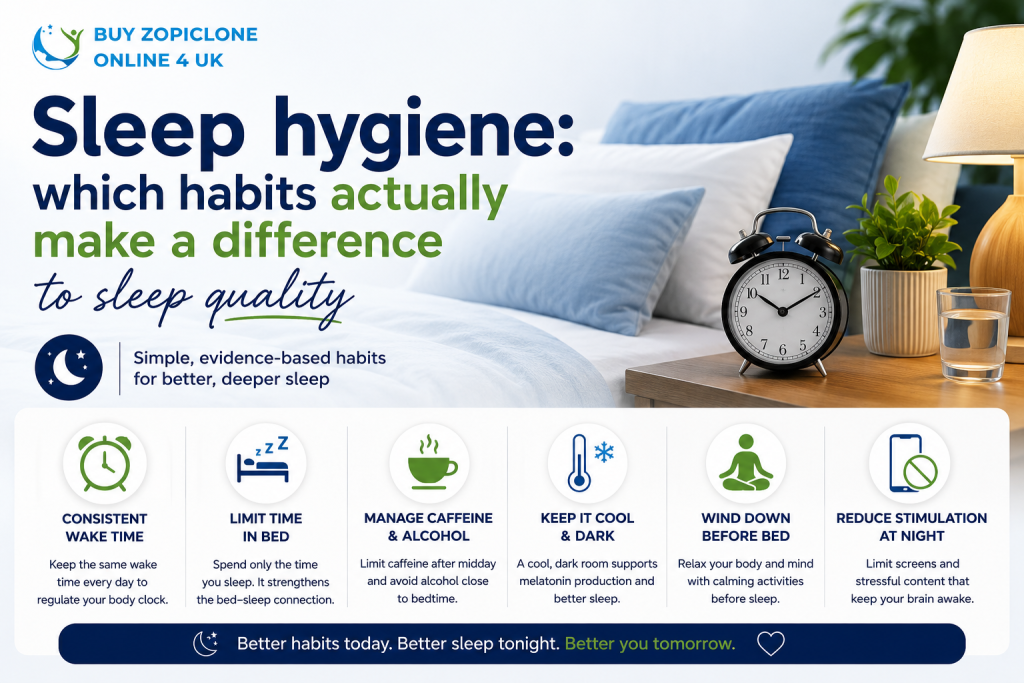
Keep a Consistent Wake Time Every Day
This is the single most impactful sleep hygiene measure and the one most people underestimate. Waking at the same time every day, including weekends, anchors your circadian rhythm and regulates the build-up of sleep pressure. Variable wake times – lying in on weekends to compensate for weekday losses – disrupt this rhythm significantly. The wake time matters more than the bedtime.
Limit Time in Bed to Actual Sleep Time
Spending long periods in bed while awake – reading, scrolling, watching television, or simply lying there hoping sleep arrives – weakens the association between the bed and sleep. The bed should function as a strong trigger for sleepiness. Time in bed that consistently exceeds actual sleep time works against this.
Manage Caffeine Timing
Caffeine has a half-life of five to six hours in most adults. A coffee at 3pm still has meaningful activity in your system at bedtime. For people sensitive to caffeine, cutting off consumption after midday is a reasonable starting point. Individual sensitivity varies considerably.
Treat Alcohol as a Sleep Disruptor
Alcohol reduces the time it takes to fall asleep but fragments sleep in the second half of the night as it is metabolised. It suppresses REM sleep and increases the likelihood of early morning waking. Reducing alcohol, particularly within three hours of bed, reliably improves sleep quality for most people.
Use the Bedroom Primarily for Sleep
Working from bed, watching television in bed, or spending long awake periods in the bedroom all weaken the sleep association. This matters most for people who already have insomnia – for good sleepers it is less consequential.
Keep the Bedroom Cool and Dark
Core body temperature drops at sleep onset and rises toward morning. A cooler bedroom – around 16 to 18 degrees Celsius for most adults – supports this process. Darkness suppresses cortisol and supports melatonin production. Blackout curtains or an eye mask can make a meaningful difference.
Habits That Are Commonly Overhyped
Avoiding Screens Before Bed
Blue light from screens does suppress melatonin, but the effect size in real-world conditions is modest. The more significant issue is cognitive stimulation – social media, news, and emotionally engaging content keep the brain in an alert state regardless of light. Night mode and blue light glasses have limited evidence. Winding down from stimulating content matters more than screen avoidance per se.
Herbal Remedies and Supplements
Melatonin has some evidence for circadian rhythm disorders and jet lag adjustment, but limited evidence for chronic insomnia specifically. Valerian, lavender, and similar supplements have weak and inconsistent evidence. They are unlikely to cause harm in most adults but should not be treated as equivalent to evidence-based interventions.
Chamomile Tea and Warm Milk
These have no meaningful pharmacological evidence for sleep. They may support a winding-down ritual, and a calm pre-bed routine has value, but the benefit is in the routine, not the specific drink.
Why Sleep Hygiene Alone Does Not Fix Chronic Insomnia
Sleep hygiene addresses environmental and behavioural factors at the margins. Chronic insomnia is typically maintained by a combination of conditioned arousal, sleep scheduling errors, and unhelpful beliefs about sleep. These require cognitive and behavioural interventions – specifically CBT-I – to address directly.
If you have been practising good sleep hygiene consistently for several weeks without meaningful improvement, that is a signal to look beyond hygiene toward a structured programme like CBT-I or a conversation with your GP.
Frequently Asked Questions
Should I Go to Bed at the Same Time Every Night?
Consistency in wake time is more important than consistency in bedtime. Going to bed when you feel genuinely sleepy – rather than at a set time regardless of sleepiness – tends to produce better results, especially for people with insomnia.
Does Exercise Help with Sleep?
Yes, with caveats. Regular moderate exercise is associated with better sleep quality and duration. Vigorous exercise within two hours of bedtime can delay sleep onset in some people, though individual responses vary. Morning or afternoon exercise is generally the safest recommendation.
Is It Bad to Nap During the Day?
For people with insomnia, daytime napping reduces sleep pressure and makes it harder to fall asleep at night. Short naps of around 20 minutes before 3pm have minimal impact for most people. Long or late naps are generally unhelpful for people struggling with night-time sleep.
How Long Does It Take for Sleep Hygiene Changes to Make a Difference?
Most people who implement consistent changes see some improvement within two to four weeks. If you see no change after a month of consistent effort, sleep hygiene is unlikely to be sufficient on its own.
Conclusion
sleeping tablets remains an important foundation for healthy sleep, but it is not a cure for chronic insomnia. Evidence strongly supports habits such as maintaining a consistent wake time, managing caffeine and alcohol intake, limiting time spent awake in bed, and creating a cool, dark sleeping environment. At the same time, many commonly promoted sleep hacks have far less scientific support than people assume.
For those struggling with persistent sleep difficulties, sleep hygiene should be viewed as the starting point rather than the entire solution. When problems continue despite consistent effort, evidence-based approaches such as CBT-I and professional medical guidance are often the most effective next steps.