

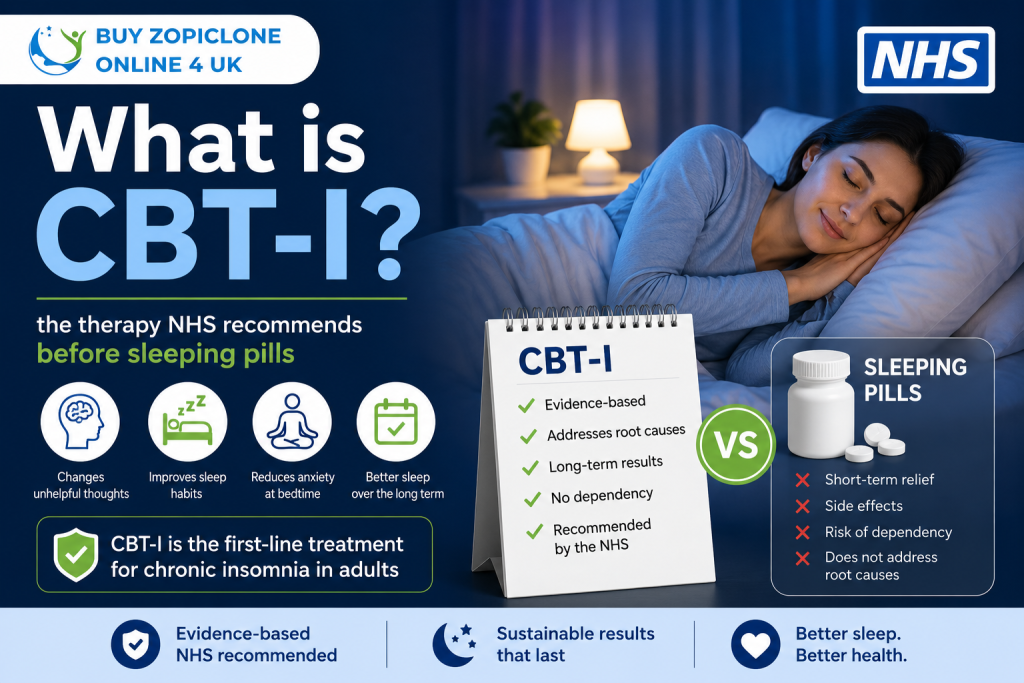
When people struggle with persistent insomnia, the instinct is often to reach for a solution – a pill, a supplement, something that provides relief quickly. But UK clinical guidelines are clear: for chronic insomnia in adults, cognitive behavioural therapy for insomnia, known as CBT-I, is the recommended first-line treatment, ahead of any medication.
That is not a minor distinction. It reflects a substantial body of evidence showing that CBT-I produces better long-term outcomes than sleeping tablets for most people, without the risks of dependency or side effects that medication carries.
So what exactly is CBT-I, how does it work, and how can you access it in the UK?
-

Zopiclone 7.5 mg (Blue)
Insomnia Price range: £105.00 through £675.00 ADD TO CART This product has multiple variants. The options may be chosen on the product page -

Zopiclone 7.5 mg (Zopisign)
Insomnia Price range: £105.00 through £675.00 ADD TO CART This product has multiple variants. The options may be chosen on the product page -

Zopiclone 10 mg (Zopisign)
Insomnia Price range: £110.00 through £685.00 ADD TO CART This product has multiple variants. The options may be chosen on the product page -

Zopiclone 7.5 mg (White Pills)
Insomnia Price range: £105.00 through £675.00 ADD TO CART This product has multiple variants. The options may be chosen on the product page
What CBT-I is
CBT-I is a structured, evidence-based psychological treatment for insomnia. It is not general therapy or relaxation advice. It is a specific programme – typically delivered over six to eight sessions – that directly targets the thoughts and behaviours that perpetuate poor sleep.
The key insight behind CBT-I is that chronic insomnia is rarely just about the original trigger. Over time, the way a person thinks about sleep, and the habits they develop in response to poor sleep, become the main maintaining factors. CBT-I addresses these directly.
The main components of CBT-I
Sleep restriction therapy
One of the most effective and counterintuitive elements. It involves temporarily limiting time in bed to match the actual amount of sleep you are getting, then gradually extending it as sleep efficiency improves. This builds sleep pressure and strengthens the association between bed and sleep. It tends to feel difficult in the first week and significantly better by week three.
Stimulus control
This component addresses the learned association between the bedroom and wakefulness. The core rule is straightforward: only use the bed for sleep. If you are awake in bed for more than 20 minutes, get up and return only when sleepy. Over time, this re-establishes the bed as a trigger for sleep rather than a trigger for lying awake.
Cognitive restructuring
Chronic insomnia is almost always accompanied by unhelpful thoughts about sleep – catastrophising about the consequences of a bad night, clock-watching, believing you are fundamentally incapable of sleeping properly. Cognitive restructuring identifies these thought patterns and replaces them with more accurate, balanced perspectives.
Sleep hygiene education
CBT-I includes guidance on behaviours that support or undermine sleep – caffeine timing, alcohol, light exposure, exercise, and bedroom environment. Sleep hygiene alone rarely resolves insomnia, but it removes obstacles that make other components less effective.
Relaxation techniques
Techniques such as progressive muscle relaxation, diaphragmatic breathing, and mindfulness are used to reduce physiological arousal at bedtime. These are particularly useful for people whose insomnia is closely tied to anxiety.
Why CBT-I works better than medication long-term
Sleeping tablets work primarily by sedating the nervous system. They can help someone fall asleep, but they do not address the cognitive and behavioural patterns that are keeping the insomnia going. When the medication stops, the insomnia typically returns.
CBT-I changes the underlying patterns. Studies consistently show that while medication produces faster initial improvement, CBT-I produces greater improvement at follow-up – typically six months and beyond – because the changes are structural rather than pharmacological. Many people continue to improve after completing the programme.
Who CBT-I is suitable for
CBT-I is suitable for most adults with chronic insomnia, including those with comorbid anxiety, depression, or chronic pain. It is also used effectively with older adults. It is not a good fit for people with untreated severe mental health conditions or those whose insomnia is primarily caused by an untreated physical condition that needs addressing first.
How to access CBT-I in the UK
- NHS IAPT (Improving Access to Psychological Therapies) – self-refer at your GP surgery or online in most areas
- Sleepstation – an NHS-commissioned digital CBT-I programme available in many areas without a referral
- Sleepio – a digital CBT-I programme with some NHS commissioning and a free trial option
- Private therapists – look for a psychologist or CBT therapist with specific experience in insomnia
- Your GP – ask specifically about CBT-I referral pathways in your area
Waiting times on the NHS vary. Digital programmes like Sleepstation and Sleepio provide access to structured CBT-I without a wait and have solid evidence bases in their own right.
Frequently asked questions
How many sessions does CBT-I take?
Typically six to eight sessions over the same number of weeks. Digital programmes are self-paced but follow the same structure. The sleep restriction component requires consistent daily effort between sessions.
Is CBT-I available on the NHS?
Yes, though availability varies by area. Sleepstation is NHS-commissioned in many regions and accessible without a GP referral. Your GP can advise on what is available locally.
Does CBT-I work if you have anxiety as well?
Yes. CBT-I is effective in people with comorbid anxiety, and the sleep improvements often have a positive knock-on effect on anxiety symptoms. Both should ideally be addressed, and a therapist with experience in both areas is ideal.
Can I do CBT-I on my own?
Some elements – sleep diaries, stimulus control rules, sleep hygiene – can be self-applied using good self-help resources. However, the full programme, particularly sleep restriction, benefits significantly from professional guidance, especially in the first two weeks when it is most challenging.