

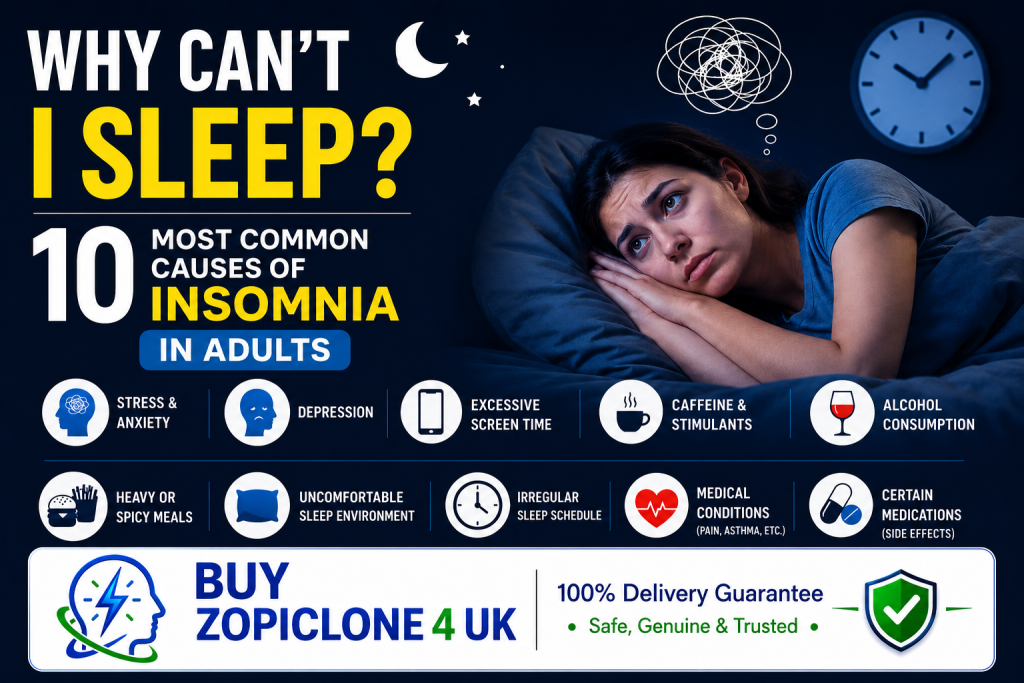
Lying awake at night, unable to switch off, is one of the most frustrating experiences there is. The harder you try to sleep, the further away it feels. But insomnia is rarely random. In most cases, there is an identifiable cause – or more often, a combination of causes – driving the problem.
Here are the ten most common reasons adults in the UK struggle to sleep, and what the evidence says about each.
-

Zopiclone 7.5 mg (Blue)
Insomnia Price range: £105.00 through £675.00 ADD TO CART This product has multiple variants. The options may be chosen on the product page -

Zopiclone 7.5 mg (Zopisign)
Insomnia Price range: £105.00 through £675.00 ADD TO CART This product has multiple variants. The options may be chosen on the product page -

Zopiclone 10 mg (Zopisign)
Insomnia Price range: £110.00 through £685.00 ADD TO CART This product has multiple variants. The options may be chosen on the product page -

Zopiclone 7.5 mg (White Pills)
Insomnia Price range: £105.00 through £675.00 ADD TO CART This product has multiple variants. The options may be chosen on the product page
1. Anxiety and chronic stress
Anxiety is the single most common driver of insomnia in adults. When the brain is in a state of heightened alertness – processing worries, rehearsing difficult conversations, anticipating problems – it actively resists the physiological shift into sleep. The relationship is bidirectional: poor sleep worsens anxiety, and anxiety worsens sleep, creating a cycle that can persist long after the original stressor has passed.
Cognitive behavioural therapy for insomnia (CBT-I) is specifically effective at breaking this cycle and is recommended by NICE as the first-line treatment.
2. Poor sleep habits and irregular routines
The body’s sleep-wake cycle – the circadian rhythm – depends on consistency. Going to bed and waking at widely varying times, spending excessive time in bed when awake, napping late in the day, and using the bedroom for activities other than sleep all weaken the association between your bed and actual sleep. This makes it progressively harder to fall asleep when you want to.
3. Caffeine
Caffeine has a half-life of roughly five to six hours in most adults, meaning half of a 3pm coffee is still active in your system at 9pm. It works by blocking adenosine receptors – adenosine being the chemical that builds up during waking hours and promotes sleep pressure. Regular caffeine consumers often underestimate how significantly it affects their sleep quality, even when they can fall asleep without difficulty.
4. Alcohol
Alcohol is widely used as a sleep aid because it is a sedative and does help people fall asleep faster. The problem is what happens in the second half of the night. As the body metabolises alcohol, sleep becomes lighter and more fragmented, REM sleep is suppressed, and early morning waking becomes common. People who drink regularly often notice reduced sleep quality without connecting it to the alcohol.
5. Depression
Depression disrupts sleep in characteristic ways – often causing early morning waking (waking two to three hours before the alarm and being unable to return to sleep) or, less commonly, excessive sleeping. Sleep disruption is both a symptom and a maintaining factor of depression, which is why treatment for insomnia needs to address both simultaneously.
6. Chronic pain
Any condition causing persistent physical discomfort – arthritis, back pain, fibromyalgia, migraines – can make it difficult to find a comfortable position, fall asleep, and stay asleep. Pain and sleep have a bidirectional relationship: poor sleep lowers pain thresholds, making pain feel more intense, which in turn further disrupts sleep.
7. Sleep apnoea
Obstructive sleep apnoea is a condition in which the airway partially or fully collapses during sleep, causing repeated brief interruptions to breathing. The person usually does not remember waking, but the cumulative effect is severely fragmented sleep. It is significantly underdiagnosed. Common signs include loud snoring, waking unrefreshed despite adequate hours, and excessive daytime sleepiness. A GP can refer for a sleep study if it is suspected.
8. Medications
Several commonly prescribed medications can interfere with sleep as a side effect. These include some antidepressants (particularly SSRIs taken in the evening), beta-blockers, corticosteroids, certain blood pressure medications, and stimulant-based ADHD medications. If your sleep problems began or worsened after starting a new medication, it is worth discussing with your prescriber.
9. Shift work and disrupted body clock
Working patterns that conflict with natural light-dark cycles – night shifts, early morning starts, rotating schedules – force the body to sleep at times that conflict with the circadian rhythm. This makes sleep feel biologically unnatural and often results in shorter, lighter, and less restorative sleep. The effects accumulate over time and can persist even on days off.
10. Conditioned arousal
This is one of the most overlooked causes of chronic insomnia. After repeated nights of lying awake in bed, the brain forms an association between the bedroom and wakefulness. The bed, which should trigger sleepiness, instead triggers alertness. This is a learned response – and it can be unlearned through techniques used in CBT-I, particularly stimulus control therapy.
What to do next
If you recognise several of these causes in your own experience, the first practical step is identifying which ones are most likely to be driving your sleep problems. Sleep diaries can help clarify patterns. A conversation with your GP is worthwhile if sleep difficulties have lasted more than four weeks or are significantly affecting your daily life.
Cognitive behavioural therapy for insomnia is the most evidence-based approach for chronic insomnia and is available on the NHS in some areas or through self-referral programmes such as Sleepstation.
Frequently asked questions
Can phone use at night cause insomnia?
Screen exposure in the evening can suppress melatonin production due to blue light, and the stimulating content of social media and news keeps the brain alert. Both factors can delay sleep onset. The effect is real but varies between individuals.
Why do I wake up at 3am every night?
Regular early morning waking is often associated with anxiety or depression, alcohol metabolism, or a natural thinning of sleep in the second half of the night that becomes problematic when stress prevents returning to sleep.
Can insomnia be cured?
Chronic insomnia is highly treatable. CBT-I produces significant and lasting improvements in the majority of people who complete it. The word “cure” implies a single intervention; managing insomnia long-term often involves maintaining good sleep habits and addressing underlying contributors as they arise.
Should I stay in bed if I cannot sleep?
No. This is one of the most counterproductive things you can do. Lying awake in bed for extended periods strengthens the association between your bed and wakefulness. Getting up after 20 minutes of wakefulness and returning only when sleepy is a core recommendation of CBT-I.