

Introduction
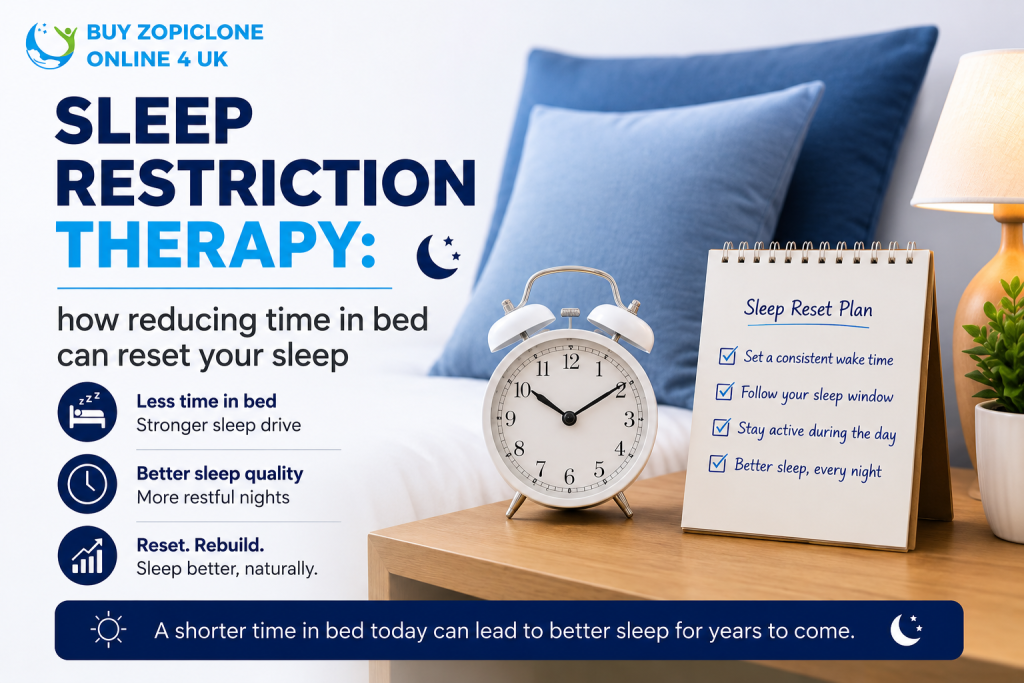
Of all the techniques used in cognitive behavioural therapy for insomnia, sleep restriction therapy is the one that surprises people most. The idea – that spending less time in bed can help you sleep better – feels completely wrong. If you are already not sleeping enough, why would you deliberately limit time in bed further?
The answer lies in sleep biology. Once you understand the mechanism, the logic becomes clear. Sleep restriction is consistently rated as one of the most effective components of CBT-I, producing significant improvements in sleep quality for the majority of people who follow it correctly.
-

Zopiclone 7.5 mg (Blue)
Insomnia Price range: £105.00 through £675.00 ADD TO CART This product has multiple variants. The options may be chosen on the product page -

Zopiclone 7.5 mg (Zopisign)
Insomnia Price range: £105.00 through £675.00 ADD TO CART This product has multiple variants. The options may be chosen on the product page -

Zopiclone 10 mg (Zopisign)
Insomnia Price range: £110.00 through £685.00 ADD TO CART This product has multiple variants. The options may be chosen on the product page -

Zopiclone 7.5 mg (White Pills)
Insomnia Price range: £105.00 through £675.00 ADD TO CART This product has multiple variants. The options may be chosen on the product page
The Problem Sleep Restriction Therapy Solves
When people develop insomnia, a natural response is to spend more time in bed – going to bed earlier, staying in bed later, or both – in an attempt to compensate for lost sleep. This feels logical, but it rarely helps. Instead, it spreads sleep thinly across a longer period, producing shallow and fragmented sleep while reinforcing the association between the bed and wakefulness.
Sleep restriction therapy breaks this pattern by doing the opposite. It consolidates sleep into a shorter and more concentrated window, strengthening sleep drive and improving sleep quality before gradually extending the sleep window again.
How Sleep Restriction Therapy Works
Step 1: Establish Your Current Sleep Picture
Before beginning sleep restriction therapy, it is important to keep a sleep diary for one to two weeks. This helps determine how much sleep you are actually getting each night – not how long you spend in bed, but how many hours you are genuinely asleep. This information provides your baseline sleep efficiency.
Step 2: Set Your Sleep Window
Your sleep window is the prescribed period during which you are allowed to be in bed. It is calculated using your average actual sleep time. For example, if you are averaging five and a half hours of sleep per night, your initial sleep window will also be five and a half hours.
You choose a fixed wake-up time and count backwards to determine your bedtime. Most practitioners recommend a minimum sleep window of five hours regardless of how little sleep you are currently getting, helping to avoid excessive sleep deprivation.
Step 3: Follow the Window Strictly
This is often the most challenging stage. You should not go to bed before your prescribed bedtime, even if you feel extremely tired. Likewise, you should wake up at the same time every day, including weekends, without exception.
Time spent outside the sleep window should be active rather than resting in bed. This consistency is essential because it strengthens the body’s natural sleep drive.
Step 4: Extend the Window as Sleep Improves
Once your sleep efficiency – the percentage of time spent asleep while in bed – consistently reaches 85 to 90 percent for five to seven consecutive days, the sleep window is extended by 15 to 30 minutes.
This process continues gradually until you reach a sleep duration that allows you to feel refreshed and rested throughout the day.
What to Expect During the First Week
The first week of sleep medication therapy is usually the most difficult. Most people feel noticeably more tired than usual, and daytime sleepiness often increases. This is expected because the build-up of sleep pressure is what helps consolidate sleep and improve its quality.
Many individuals begin noticing meaningful improvements during the second and third weeks. By the end of a structured CBT-I programme, a majority of participants report sleeping significantly better than before they started and often better than they have in years.
What Sleep Restriction Therapy Is Not
Sleep restriction therapy is not the same as simply sleeping less. The objective is not permanent sleep reduction but temporary sleep consolidation followed by gradual and structured expansion of the sleep window.
The ultimate goal is to identify the amount of sleeping tablets body genuinely needs – no more and no less.
It is also different from staying awake all night or attempting an informal sleep reset. The effectiveness of sleep restriction comes from its structured approach, including a fixed sleep window, daily monitoring, and systematic adjustment over time.
Who Should Approach Sleep Restriction with Caution?
Although sleep restriction therapy is highly effective for many adults with chronic insomnia, it is not suitable for everyone.
People with epilepsy should exercise caution because sleep deprivation may lower the seizure threshold.
Individuals with bipolar disorder should seek medical advice before attempting sleep restriction, as reduced sleep can sometimes trigger hypomanic episodes.
Those working in safety-critical occupations where daytime drowsiness could create risks should also consult a healthcare professional.
People experiencing severe untreated depression should discuss sleep restriction therapy with a qualified clinician before beginning.
For most adults with chronic insomnia who do not fall into these categories, sleep restriction therapy is generally considered safe when followed correctly.
The Benefits of Professional Support
Sleep restriction therapy is often most effective when completed as part of a comprehensive CBT-I programme under professional guidance. A therapist can help determine the appropriate initial sleep window, address challenges that arise during the first few weeks, and manage the gradual expansion process correctly.
Several digital CBT-I programmes, including Sleepstation and Sleepio, incorporate guided sleep restriction therapy as a central component.
Although self-directed sleep restriction is possible using reliable educational resources, many people find the first two weeks considerably easier when they have access to professional support.
Frequently Asked Questions
Will I Feel Exhausted the Entire Time?
The first week usually involves increased tiredness, especially during the evening. However, this often improves significantly as sleep becomes more consolidated, typically during weeks two and three. The temporary increase in fatigue is generally considered a sign that the technique is working.
What If I Cannot Stay Awake Until My Prescribed Bedtime?
This is one of the most common challenges. Remaining active, taking a short walk, engaging in light household tasks, or avoiding overly comfortable seating can help. The key rule is simple: do not go to bed before your prescribed bedtime, regardless of how tired you feel.
How Long Does Sleep Restriction Therapy Take to Work?
Most people notice meaningful improvements within two to four weeks. Reaching a fully optimised sleep window generally takes six to eight weeks as part of a structured CBT-I programme.
Can I Use Sleep Restriction Therapy If I Work Shifts?
Sleep restriction becomes more complicated for people with irregular schedules. A therapist experienced in CBT-I can adapt the approach for shift workers, but it typically requires more careful planning and monitoring than it does for individuals with a fixed daily schedule.
Conclusion
Sleep restriction therapy is one of the most effective evidence-based treatments for chronic insomnia. Although the concept of spending less time in bed may initially seem counterintuitive, the technique works by strengthening sleep drive and improving sleep efficiency.
By consolidating sleep into a focused window and gradually expanding that window as sleep quality improves, many people achieve significant and lasting improvements in their sleep. While the first week can be challenging, those who follow the process consistently often experience better sleep quality, improved daytime functioning, and greater confidence in their ability to sleep naturally.For individuals who continue to struggle with chronic insomnia despite behavioural approaches, it may be appropriate to discuss additional treatment options with a healthcare professional. In some cases, prescription sleep medications such as Zopiclone 7.5mg may be considered as part of a broader sleep management plan. However, Zopiclone 10mg is generally intended for short-term use and should be taken only under appropriate medical guidance.