

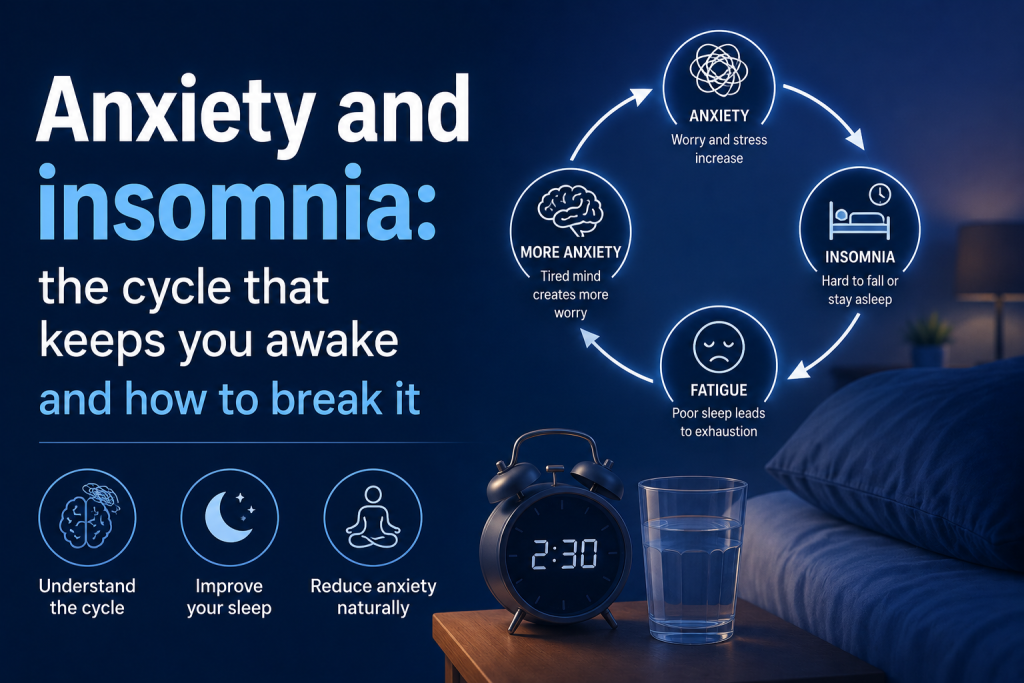
Of all the causes of insomnia, anxiety is the most common and the most tenacious. It does not simply cause sleep problems – it actively maintains them long after the original trigger has passed. Understanding why requires looking at how anxiety and sleep interact at a biological and psychological level, and why the usual instinct of trying harder to sleep makes things considerably worse.
How anxiety causes insomnia
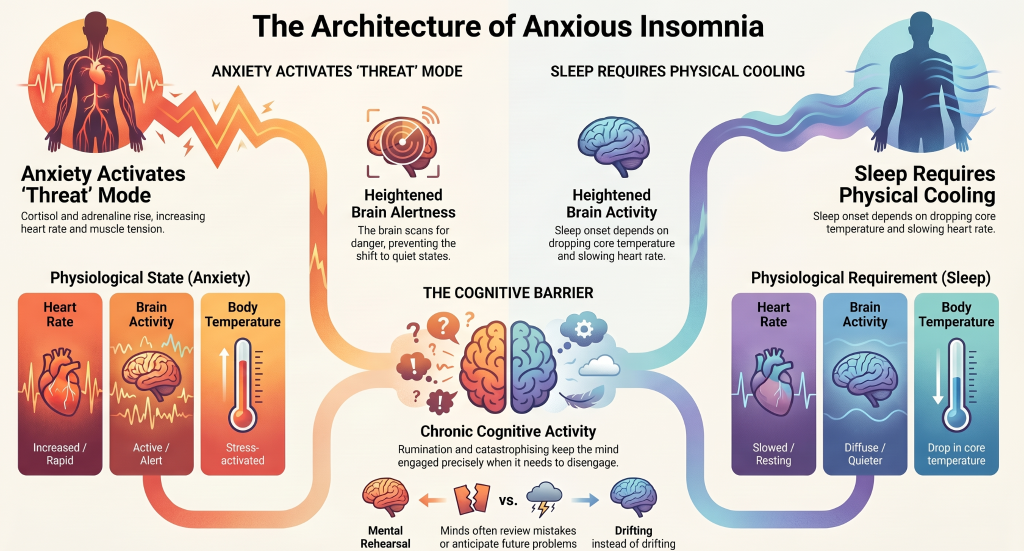
Anxiety activates the body’s stress response – a cascade of physiological changes designed to prepare for threat. Cortisol and adrenaline rise. Heart rate increases. Muscles tighten. The brain shifts into a state of heightened alertness, scanning for danger.
This state is the biological opposite of what sleep requires. Sleep onset depends on a drop in core body temperature, a slowing of heart rate, and a shift in brain activity from active processing toward quieter, more diffuse states. When the stress response is active, none of this happens naturally.
Beyond the physical arousal, anxiety generates cognitive activity – rumination, worry, catastrophising – that keeps the mind engaged precisely when it needs to disengage. The person lies in the dark, and instead of drifting toward sleep, they are rehearsing tomorrow’s difficult conversation, reviewing today’s mistakes, or anticipating future problems.
How insomnia worsens anxiety
The relationship runs in both directions. Sleep deprivation directly impairs the brain’s ability to regulate emotion. The amygdala – the region involved in fear and threat detection – becomes more reactive after poor sleep. The prefrontal cortex, which normally provides rational regulation of emotional responses, becomes less effective.
The result is that anxiety feels more intense, more difficult to manage, and more credible after a bad night. This in turn makes the following night harder, which worsens anxiety further. Without intervention, this cycle is self-sustaining and tends to persist well beyond the circumstances that originally triggered it.
The third layer: anxiety about sleep itself
People with chronic insomnia often develop a specific form of anxiety that is distinct from their general anxiety: worry about sleep itself. They begin to monitor their sleep closely, dreading the approach of bedtime, watching the clock, calculating how many hours remain before they need to be up.
This anticipatory anxiety about sleep is one of the most significant maintaining factors of chronic insomnia. The bedroom – which should be associated with rest – becomes associated with the unpleasant experience of lying awake. The bed triggers alertness rather than sleepiness. This learned association is a core target of cognitive behavioural therapy for insomnia.
What tends not to work
Several instinctive responses to anxiety-related insomnia are counterproductive:
- Trying harder to sleep – effort and sleep are incompatible; the more conscious attention you direct at sleeping, the more elusive it becomes
- Going to bed earlier to compensate – this increases time lying awake, strengthening the bed-wakefulness association
- Monitoring sleep with apps or trackers – this increases sleep-related anxiety for most people with insomnia
- Reassuring yourself that you will catch up at the weekend – irregular sleep timing undermines the circadian rhythm and makes weekday nights harder
- Alcohol as a sleep aid – reduces sleep quality in the second half of the night and increases next-day anxiety
What actually breaks the cycle
Cognitive behavioural therapy for insomnia
CBT-I is the most evidence-based intervention for anxiety-related insomnia. It directly targets both the behavioural patterns (time in bed, sleep scheduling, stimulus control) and the cognitive patterns (catastrophising about sleep, monitoring, anticipatory anxiety) that maintain the cycle. NICE recommends it as the first-line treatment.
Addressing the anxiety itself
When anxiety is the primary driver, treating the insomnia in isolation has limited reach. CBT for anxiety – available through NHS IAPT services or privately – addresses the underlying thought patterns and physiological reactivity. Many people find that as anxiety improves, sleep follows.
Reducing physiological arousal before bed
Practical techniques that reduce the physical component of anxiety in the hour before bed include diaphragmatic breathing, progressive muscle relaxation, and body scan meditation. These are not cures for insomnia but can help lower arousal enough to make sleep more accessible when combined with structural changes.
Stimulus control
Getting out of bed when awake rather than lying there anxious, and returning only when genuinely sleepy, is one of the most effective single steps for breaking the learned association between bed and wakefulness. It is one of the core techniques of CBT-I.
When to seek professional help
If anxiety is significantly affecting your sleep and daily functioning, a conversation with your GP is worth having. GPs can refer for CBT through IAPT, discuss whether medication might play a short-term role, and help identify whether there is an underlying anxiety disorder that needs direct treatment.
You do not need to have a diagnosed anxiety disorder to seek help. Persistent sleep difficulty driven by worry and stress is a legitimate reason to speak to your doctor.
Frequently asked questions
Can anxiety cause insomnia even when I do not feel anxious during the day?
Yes. Physiological hyperarousal – elevated baseline nervous system activation – can maintain insomnia even when conscious anxiety is not prominent. People often describe it as a racing mind at night without being able to identify specific worries.
Which comes first – the anxiety or the insomnia?
Either can come first. Sometimes anxiety triggers insomnia; sometimes a period of poor sleep triggers anxiety. What matters clinically is that both need to be addressed, because treating only one is rarely sufficient for lasting improvement.
Will sleeping tablets help with anxiety-related insomnia?
They may provide short-term relief from the symptom of sleeplessness, but they do not address the anxiety maintaining it. NICE recommends CBT- I as the first-line treatment. Medication is considered for short-term use in severe cases or as a bridge to therapy.
How long does it take to break the anxiety-insomnia cycle?
With CBT-I, most people see meaningful improvement within four to eight weeks. The cognitive changes – reducing anticipatory anxiety and changing the relationship with the bedroom – take somewhat longer but are more durable.