

If you have spoken to your GP about insomnia, you may have been prescribed zopiclone – or you may have been offered something different. Understanding the landscape of sleep medications available in the UK, and how GPs decide between them, can help you have a more informed conversation with your doctor.
This article is purely informational. It does not recommend any specific medication, and all decisions about sleep medication should be made with your prescribing GP based on your individual circumstances.
The starting point: medication is not always the first option
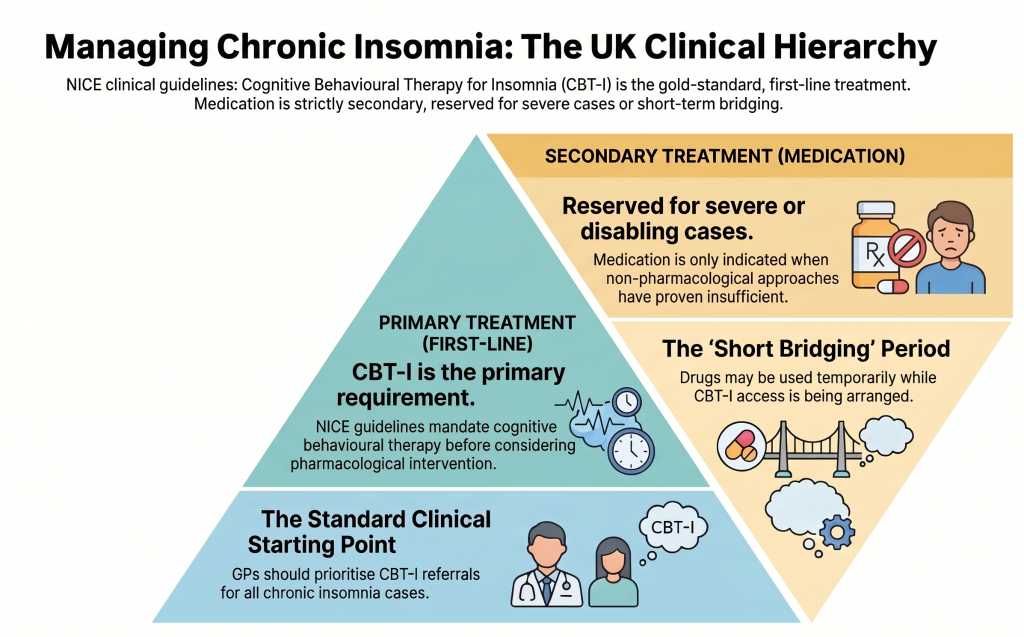
Before covering the different medications, it is important to note that UK clinical guidelines – specifically NICE – are clear that cognitive behavioural therapy for insomnia (CBT-I) is the first-line treatment for chronic insomnia. Medication is recommended only when insomnia is severe or disabling and other approaches have not been sufficient.
GPs who follow NICE guidance will typically discuss or refer for CBT-I before prescribing sleeping medication for chronic insomnia, or prescribe medication only for a short bridging period while CBT-I access is arranged.
Zopiclone
Zopiclone is a non-benzodiazepine hypnotic – a Z-drug – that works by enhancing GABA activity in the brain to produce sedation. It is one of the most commonly prescribed sleep medications in the UK.
Typical use: short-term (two to four weeks maximum). Recommended for adults with severe insomnia causing significant functional impairment. Not recommended as a long-term solution due to dependence risk.
Most commonly reported side effect: a bitter or metallic taste. Next-day drowsiness is also common.
Temazepam
Temazepam is a benzodiazepine – an older class of medication with similar sedative effects to zopiclone. It was more commonly prescribed in previous decades but has largely been replaced by Z-drugs in routine prescribing for insomnia due to its higher dependence potential and longer half-life.
GPs may still prescribe temazepam in specific circumstances, but it is generally considered a second-choice option for sleep, and prescribing is more restricted. It is a Schedule 3 controlled drug.
Nitrazepam and other benzodiazepines
Nitrazepam is another benzodiazepine used historically for insomnia. It has a long half-life – effects can persist well into the following day – which increases the risk of next-day impairment and accumulation with repeated doses. It is rarely a first-choice option and is infrequently prescribed for new cases of insomnia.
Melatonin (Circadin)
Melatonin is a hormone naturally produced by the body in response to darkness. Circadin is a prolonged-release melatonin preparation licensed in the UK for short-term treatment of primary insomnia in adults aged 55 and over.
It works differently from zopiclone and benzodiazepines – rather than sedating the central nervous system, it supports the regulation of the circadian rhythm. It is not a sedative in the conventional sense and does not carry the same dependence risks.
GPs often consider melatonin for older adults in whom the sedation and fall risk associated with zopiclone are particular concerns. It is also used for jet lag and circadian rhythm disruption. Its effectiveness for insomnia in younger adults is less well supported.
Low-dose antidepressants
Low doses of certain antidepressants – particularly mirtazapine and amitriptyline – have sedating properties and are sometimes prescribed off-label for insomnia, particularly when there is a comorbid mood disorder. They do not carry the same dependence risks as Z-drugs or benzodiazepines.
This approach is more likely to be considered when insomnia is accompanied by depression or anxiety, or when other medications have not been appropriate.
Over-the-counter antihistamines
Products such as Nytol (diphenhydramine) and Sominex are available without prescription and are based on antihistamines with sedating properties. They are intended for short-term use only. Tolerance develops quickly – often within a few nights – meaning they become less effective rapidly. They are not recommended for chronic insomnia and can cause significant next-day drowsiness.
How GPs decide which medication to prescribe
There is no single answer. A GP’s choice of sleep medication depends on several factors specific to the individual patient:
- Age – older adults are steered toward lower- risk options due to fall and cognitive side effect concerns
- Other health conditions – liver or kidney disease, sleep apnoea, and respiratory conditions all affect suitability
- Other medications – potential interactions with existing prescriptions
- History of substance dependence – Z- drugs and benzodiazepines are avoided or used with extreme caution
- The nature of the insomnia – difficulty falling asleep versus staying asleep, or early morning waking, may point toward different options
- Whether depression or anxiety is a contributing factor – may make low-dose antidepressants more appropriate
A GP who follows NICE guidance will also consider whether CBT-I has been offered, discussed, or is accessible before prescribing.
The shared limitation of all sleep medications
Regardless of which medication is prescribed, all current sleep medications share an important limitation: they treat the symptom of insomnia rather than its cause. When the medication stops, insomnia typically returns unless the underlying contributing factors have been addressed.
This is the core reason that NICE and sleep specialists consistently emphasise CBT-I as the preferred treatment. CBT-I addresses the behavioural and cognitive patterns that perpetuate insomnia – and the improvements it produces tend to be lasting.
Frequently asked questions
Is zopiclone stronger than temazepam?
They work through similar mechanisms and produce similar effects. Temazepam has a slightly longer half-life, which can mean more pronounced next-day effects. Neither is inherently stronger – the appropriate choice depends on individual clinical factors and is a decision for your GP.
Can I switch from zopiclone to melatonin?
Melatonin and zopiclone work very differently. Whether switching is appropriate – and how to do it safely – depends entirely on your individual situation and should be discussed with your GP. Do not stop zopiclone abruptly without medical guidance.
Why won’t my GP prescribe sleeping tablets long-term?
Because the evidence does not support long-term use. NICE guidelines recommend short-term prescribing only, due to dependence risk, side effects, and the fact that medication does not address the underlying causes of chronic insomnia. CBT- I is what the evidence supports for long-term management.
Are herbal sleep remedies safer than zopiclone?
They carry fewer dependence risks, but there is much less evidence for their effectiveness. They should not be assumed to be risk-free – some interact with other medications. For chronic insomnia, evidence-based options like CBT-I are more likely to produce meaningful and lasting results.