

Most adults experience poor sleep at some point. Stress, illness, life changes, and disrupted routines can all affect sleep temporarily. In many cases, sleep returns to normal once the disrupting factor passes.
But there are situations where sleep problems have moved beyond temporary disruption and need professional attention. Knowing the difference – and knowing what a GP can actually offer – helps you decide when to make that appointment.
Signs that your sleep problem needs a GP appointment
It has lasted more than four weeks
Short-term insomnia, by definition, resolves within three months. When sleep difficulties have persisted for four weeks or more without clear improvement, it is reasonable to speak to a GP. This is particularly true if you have already tried adjusting your sleep habits without meaningful results.
It is significantly affecting your daily functioning
Occasional tiredness is manageable. But when poor sleep is affecting your ability to concentrate at work, impairing your decision-making, causing you to make errors you would not normally make, or affecting your relationships and mood, it has crossed into territory that warrants attention.
You are experiencing symptoms of depression or anxiety
Sleep difficulties and mental health problems are closely linked and each worsens the other. If you are experiencing persistent low mood, loss of interest in things you normally enjoy, excessive worry, or difficulty controlling anxiety alongside your sleep problems, speak to your GP about both. They are best addressed together.
You wake feeling unrefreshed despite adequate hours
If you are regularly getting seven or more hours in bed but consistently waking feeling as though you have not slept, something may be interrupting the quality of your sleep. Sleep apnoea is a common cause that frequently goes undiagnosed. Other medical conditions can also affect sleep quality independently of its duration.
Your partner reports snoring, gasping, or breathing pauses
These are hallmark signs of obstructive sleep apnoea. If you regularly wake yourself with a jolt, have been told you snore loudly, or have been observed to stop breathing briefly during sleep, tell your GP. Sleep apnoea is treatable and, left unaddressed, is associated with serious cardiovascular risks over time.
You are relying on alcohol or over-the-counter products regularly
Using alcohol to fall asleep or regularly reaching for antihistamine sleep aids to get through the night are signs that you have moved beyond normal sleep variation into territory where a more structured approach is needed. Both strategies tend to make the underlying problem worse over time.
You are experiencing unusual symptoms during sleep
Behaviours including sleepwalking, acting out dreams, or extreme restlessness of the legs at night all warrant a GP conversation. Restless legs syndrome, REM sleep behaviour disorder, and other parasomnias are diagnosable and treatable conditions.
What a GP can offer
Assessment and diagnosis
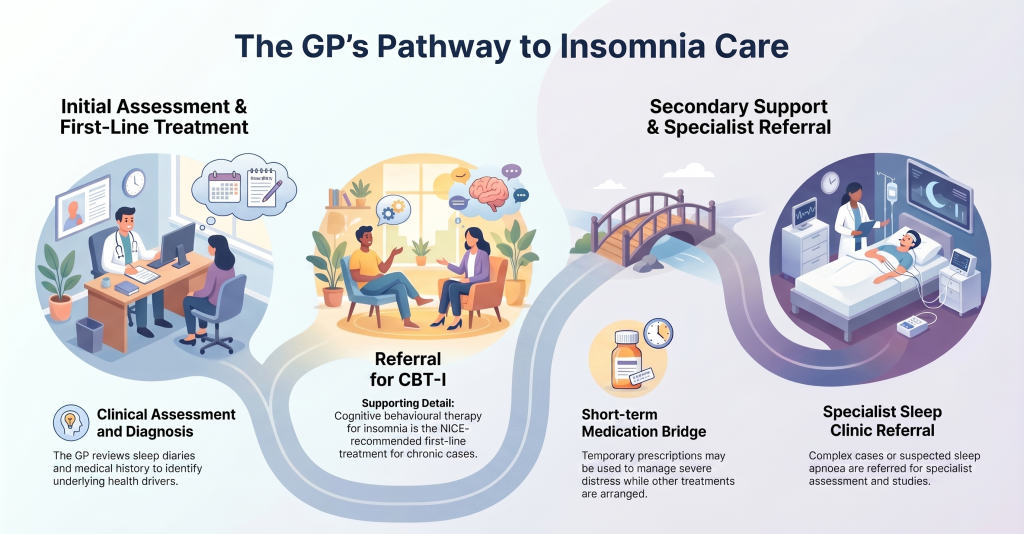
A GP will take a detailed history of your sleep patterns, lifestyle, and overall health. They may ask you to keep a sleep diary before or after your appointment. They will consider whether an underlying physical or mental health condition might be driving the sleep problem – because treating the cause is nearly always more effective than treating the symptom.
Referral for CBT-I
NICE guidelines recommend cognitive behavioural therapy for insomnia as the first-line treatment for chronic insomnia. Your GP can refer you through NHS IAPT services, which offer self-referral in most areas, or may be able to point you toward commissioning-funded digital programmes such as Sleepstation.
Short-term medication
If your insomnia is severe and causing significant distress, a GP may prescribe a short course of sleeping medication as a bridge while other approaches are arranged. This is intended as a temporary measure, not a long-term solution. Any prescription will be accompanied by a review.
Referral to a sleep clinic
For suspected sleep apnoea, significant parasomnias, or complex cases that do not respond to standard approaches, a GP can refer to a sleep clinic for specialist assessment. Sleep studies – which can now often be done at home – can identify specific sleep disorders that standard insomnia treatment would not address.
How to prepare for your appointment
A GP appointment for sleep problems is more productive with some preparation:
- Keep a brief sleep diary for one to two weeks beforehand – note when you go to bed, roughly when you sleep, when you wake, and how you feel during the day
- Note any patterns you have observed – whether it is worse on certain nights, whether worry or pain is involved, whether alcohol or caffeine timing seems relevant
- Write down all the medications and supplements you are taking – some have sleep effects that are not obvious
- Be honest about alcohol consumption – GPs need accurate information to help effectively
- Note how long the problem has been going on and whether it has changed over time
Self-referral options that do not require a GP
In many parts of England, you can access NHS talking therapies – including support for insomnia and sleep-related anxiety – without a GP referral through the IAPT self-referral system. Sleepstation, an NHS-commissioned digital CBT-I programme, also accepts self-referrals in many areas.
These are not substitutes for seeing a GP if the signs above apply, but they can be useful while waiting for an appointment or as an additional resource alongside GP care.
Frequently asked questions
Will my GP just prescribe sleeping tablets?
Not necessarily. GPs following current NICE guidance will discuss CBT-I as the preferred approach for chronic insomnia. If medication is prescribed, it should be short-term and accompanied by a plan for review. If you are offered medication without a discussion of alternatives, it is reasonable to ask about CBT-I.
What if my GP does not take my sleep problems seriously?
Sleep problems are legitimate medical concerns with well-established treatment pathways. If you feel dismissed, you can ask specifically about referral for CBT-I through IAPT, or self-refer directly to IAPT or Sleepstation. You can also request a second opinion.
Do I need a diagnosis of insomnia to access CBT-I?
Not necessarily. CBT-I programmes, particularly digital ones like Sleepstation and Sleepio, are accessible to people with self-reported sleep difficulties. A formal diagnosis is not always required to self-refer.
How long is the NHS waiting time for sleep support?
This varies significantly by area. IAPT waiting times differ across the country. Digital programmes offer much faster access. Your GP can advise on local options and timelines.